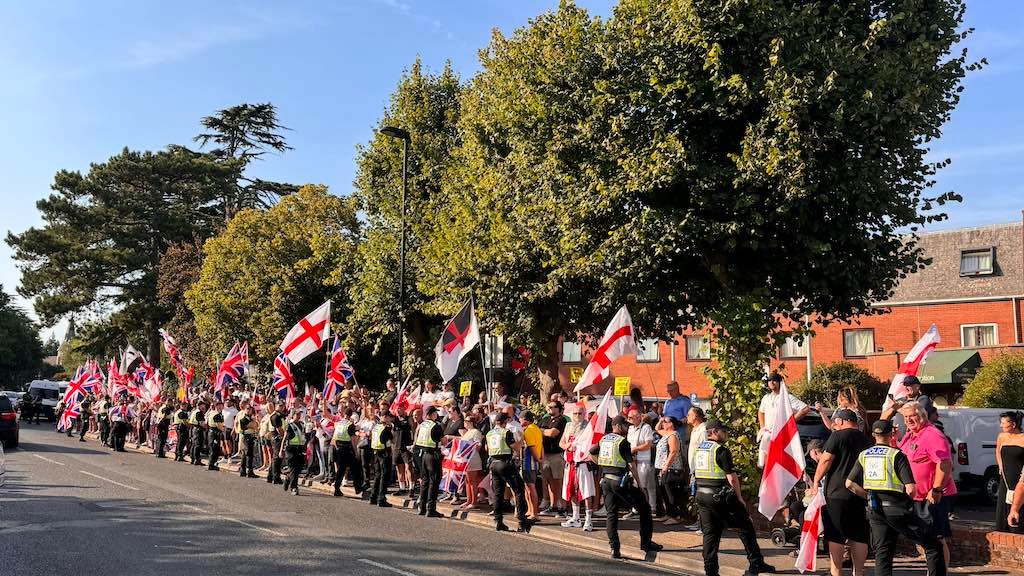
Across Southampton, familiar public spaces have become contested ground in a symbolic struggle over identity and belonging. Red crosses spray-painted on roundabouts, Union Jacks draped from lampposts, and growing protests outside asylum seeker accommodation reveal a city caught at the intersection of patriotism, protest, and political tension.
Southampton and the UK has seen these tensions play out on the streets. In Bowthorpe, Essex demonstrators gathered outside the Brook Hotel, which houses asylum seekers. On 22 August in Portswood, right-wing activists again targeted a hotel, only to be met by counter-protests from the left-leaning Southampton Stand Up to Racism. Police lines and metal barriers underscored the seriousness of the standoff.
One local resident, speaking to In-Common Southampton, described the scene: “It was shocking to witness this hatred… many wore T-shirts with ‘Southampton Patriots’ and even children were wrapped in St George’s Cross flags.” The sight of patriotic symbols used in this context, he said, “sent a chill through the neighbourhood.”
For many residents, the proliferation of flags is simply an expression of English pride. But others warn the symbolism is being weaponised, deepening community divisions and leaving immigrant families feeling increasingly uneasy. Experts have noted how the St George’s Cross—once a straightforward emblem of national identity—has become contested: patriotic to some, an emblem of exclusion to others.
Nationally, experts attest the symbolic use of St George’s Cross has become divisive. While some see it as patriotic, others connect it to far-right nationalism, particularly at a time when immigration and asylum dominate political debates. The irony of the St Georges cross being that St Georges parents were both Turkish and Palestinian, likely to be immigrants themselves. This irony seems to go over the flag flyers head as well as the almost comical lack of knowledge.
The city now faces tough questions. Do unchecked displays of national symbols risk intimidating asylum seekers and minority communities? Can civic pride be celebrated without sliding into exclusion? And what role should city leaders play in maintaining balance?
Southampton City Council leader Cllr Lorna Fielker has condemned the surge in anti-immigration demonstrations, reaffirming Southampton’s status as a City of Sanctuary. In a statement, she said: “Southampton has a long history of welcoming people from around the world and for being a City of Sanctuary. I support the right to peaceful protest, but I am disappointed that there is an anti-immigration demonstration scheduled. Disinformation is being shared with the clear intention to incite hate and increase tensions in local communities.”
The council’s recent decision to remove flags from public areas—citing health, safety, and distraction concerns—has itself divided opinion. Some residents accused officials of wasting resources, even as they spent their own time festooning flagpoles and roundabouts in protest. The debate over priorities, identity, and belonging continues to simmer.
For now, Southampton remains a city at a crossroads—its streets and symbols caught in the crossfire between pride and protest, inclusion and exclusion, the local and the national. As the conversation rages on, the challenge for leaders and residents alike is to ensure public spaces remain places of welcome, not division.